


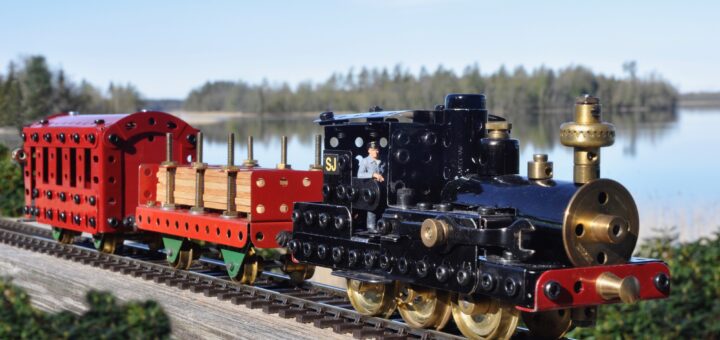
Unique Exhibition: Meccano 1925–2025
This summer you can see Anders Holmberg’s exciting home-built models and historical exhibition celebrating 100 years of Meccano 1925–2025.
Would you like to meet Anders Holmberg?
Anders will be present at Minivärlden to talk, demonstrate and answer questions.
Dates: 29 June, 4 July, 8 July, 13 July, 20 July, 27 July, 1 August, 8 August. Time: 11 am – 2 pm.
How did it begin?
When I was 10 years old, I received my first Meccano set. It was in the mid-1950s, during Meccano’s red-and-green period. I also had the Swedish construction set TEKNIK, which had blue and red parts. These two makes are fully compatible.
As I entered my teenage years, other interests took over and my Meccano sets were put on the shelf. This early interest in technology led me to train as a structural engineer, a profession I worked in for many years. For the past forty years, however, I have worked as a freelance draughtsman, producing technical illustrations for companies and advertising agencies.

It was not until 2015, when our grandchildren spotted my old Meccano and the boxes were dusted off, that my interest in building with Meccano was rekindled. For the grandchildren, who had grown up with LEGO, the nuts and bolts were something quite different – but just as with me, their interest faded as they reached their teenage years.
I have since expanded my collection of Meccano parts by buying from private individuals, shopping on Tradera and Blocket, and ordering parts from England. In the models I have built freehand, I have used parts from 1925 through to 2025. It is fascinating to be able to follow the development of such a fine construction system, which has in all likelihood inspired many young people to pursue an interest in technology.
Meccano – A Brief History
Frank Hornby, who invented the Meccano system, was born in 1863 in Liverpool and began his business there in 1901. The sets were originally called Mechanics Made Easy, and it was not until 1907 that Meccano Ltd was registered and Hornby filed a patent for his invention. Initially there were six basic sets: X, A, B, C, D, E.
From 1916 to 1967, the monthly English hobby magazine the Meccano Magazine was published, with the motto: “To help Meccano boys have more fun than other boys.”
By 1930, classic Meccano can be said to have reached its peak. Frank Hornby died in 1936, and after his death the sets were numbered 1–10, with set 10 remaining a prestige set to this day. Sets 1–4 are regarded as “beginner sets” and sets 5–10 are intended for enthusiasts.
Meccano Ltd switched to war production during the Second World War. In 1942, all toy manufacturing was banned. The company had begun post-war production with great difficulty, but 1956 proved to be the best year since the war. The small toy cars Dinky Toys and the clockwork model trains Hornby Train were also part of Meccano Ltd.


